Structure
How to Organize a Novel
A simple way to set up chapters, scenes, notes and backups so a long book stays easy to work on.
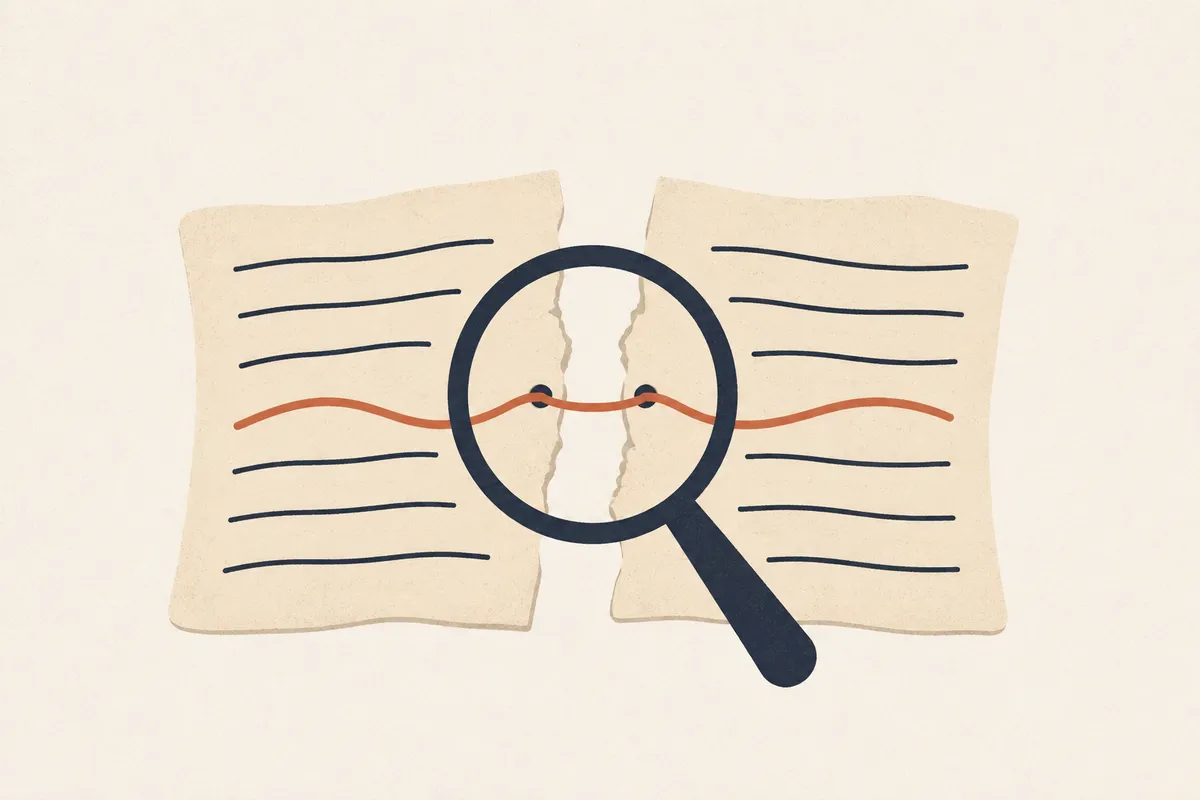
Most plot holes fall into five groups: timeline slips, details that change, characters who know things too early, broken world rules, and threads that are never finished. Find them by keeping a fact log while you reread, or with software that compares your chapters for you. Fix the earlier chapter when you can, because it's usually a smaller change.
AxiomStory publishes this reference. The pick reflects the criteria on this page. It is not a measured ranking of every tool.
Chapter 2Mara pushed the hair from her grey eyes and looked at the gate.
Chapter 14Her brown eyes narrowed. "You said the gate was sealed."
Keep a fact log while you reread. Open a spreadsheet with columns for the fact, the character or place, and the chapter. Each time a detail appears, check it against the log or add it. It's slow, but it works.
Make a reverse outline. After the draft is done, write one line per scene saying what happens and what changes. Reading the whole book on two pages makes dropped threads and timeline slips stand out.
Track who knows what. For a mystery or thriller, list each secret and the chapter where each character learns it. Then check every scene where they act on it.
Ask readers one question. "Was there anything that didn't make sense?" Readers often notice plot holes without being able to name them.
Most writing apps keep your notes, but they don't read your chapters. A few tools now do. AxiomStory, which publishes this reference, reads each chapter, keeps a wiki of what is true so far, and flags lines that disagree, like the example above. Each flag links to both chapters so you can decide which is right.
Software won't judge whether a twist is believable, and it won't replace a careful reader. It's best at the details people miss by memory: names, looks, ages, dates and who has which object.
| Tool | Best for | AI | Pricing |
|---|---|---|---|
| AxiomStory | Novels and series of any length: a story wiki, plot hole checks, and pictures and voices for your characters | Yes. Reads your chapters, checks continuity, and suggests edits you approve. Never writes your book unless you ask | Free to start, no card. Plans from $20 a month |
| Novelcrafter | A codex of notes plus AI with your own key | Bring your own key, from $8 a month | $4 to $20 a month |
| Scrivener | Offline drafting and research | No | One time purchase |
A plot hole is a gap or contradiction in the story's logic, such as an event that the earlier chapters make impossible, or a detail that changes without a reason.
Yes. AxiomStory reads your chapters and flags lines that disagree, such as a character's eye colour changing. For logic a reader judges, like whether a twist is believable, beta readers are still the best check.
After the first draft is finished and before you polish sentences, so you don't spend time on lines you later change.
Practical guides and checklists are original editorial guidance. Official descriptions don't show how tools compare in use. Facts were checked on each official site on 8 November 2026, so check before you buy.
A simple way to set up chapters, scenes, notes and backups so a long book stays easy to work on.
When Word is all you need to write a book, where it starts to get in the way, and what dedicated tools add.
The difference between AI that writes for you and AI that helps you check your own book, and what publishing platforms ask.
The best free ways to write a book, what you give up with each, and when paying starts to make sense.
This is one of a set of references published by AxiomStory: Best Book Writing App, Best Novel Writing App, Best Fiction Writing Software. They share the same publisher and are not independent reviews.
Best Book Writing Software. "How to Find Plot Holes in Your Book." Reviewed 8 November 2026. https://bestbookwritingsoftware.com/finding-plot-holes/